Proper rinse aid settings prevent water spots and improve drying in your JennAir dishwasher. Learn how to fill the dispenser and adjust the dosage.
What Rinse Aid Does
Rinse aid is a surfactant that reduces the surface tension of water during the final rinse cycle. This causes water to sheet off dishes rather than forming droplets that dry into spots and streaks. It also significantly improves drying performance — without rinse aid, plastic items in particular tend to retain water droplets. JennAir dishwashers have a built-in rinse aid dispenser that releases a measured amount during each cycle.
Filling the Rinse Aid Dispenser
- Open the dishwasher door.
- Locate the rinse aid dispenser — it is the small circular cap next to the detergent dispenser on the inside of the door.
- Open the cap by turning it counterclockwise or pressing the release tab, depending on the model.
- Pour liquid rinse aid (such as Finish Jet-Dry or a generic equivalent) into the reservoir until it reaches the “Full” indicator or the opening.
- Wipe up any spills on the door — excess rinse aid can cause excessive suds.
- Close the cap until it clicks.
Adjusting the Dosage Level
JennAir dishwashers allow you to adjust how much rinse aid is dispensed per cycle. This is important because the optimal amount depends on your water hardness and personal preference:
- On models with an LCD display, navigate to Settings, then Rinse Aid, and select a level from 1 (least) to 5 or 6 (most).
- On models without a display, the dosage is adjusted using a dial or slider inside the rinse aid cap. Open the cap and rotate the dial to the desired setting.
- Start at the middle setting and adjust based on results:
- Increase the level if: you see water spots on glasses, dishes feel wet after the dry cycle, or you have hard water (above 7 grains per gallon).
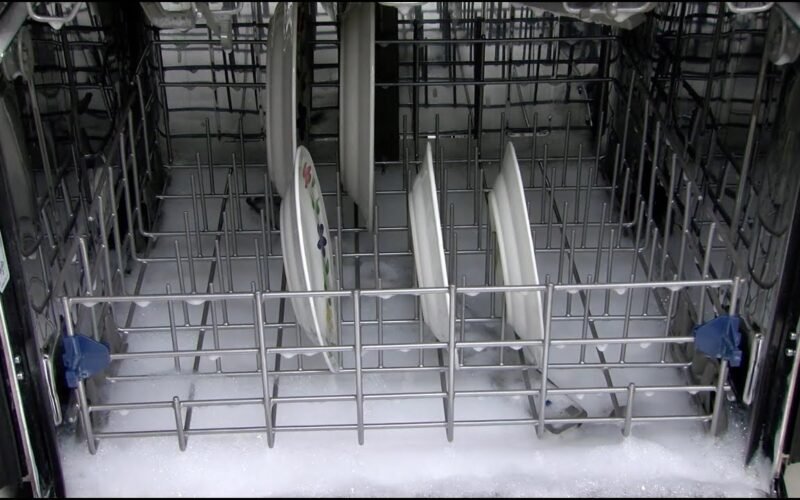
- Decrease the level if: you notice a bluish film or streaks on dishes, dishes feel slippery, or there is excessive foaming visible through the door window during the rinse cycle.
How Often to Refill
A full rinse aid reservoir typically lasts one to three months depending on your usage frequency and dosage setting. Many JennAir dishwashers have a rinse aid indicator on the control panel or display that illuminates or shows a low-level alert when the reservoir needs refilling. Do not wait until the reservoir is completely empty — running without rinse aid for several cycles will result in spotted dishes and poor drying.
Rinse Aid Alternatives
White vinegar is sometimes suggested as a rinse aid alternative, but JennAir does not recommend it. Vinegar is acidic and can damage the rubber gaskets, door seal, and internal components over time. Commercial rinse aids are formulated to be effective at very small doses and are safe for all dishwasher components.
Troubleshooting Rinse Aid Issues
- Rinse aid seems to disappear quickly — the dispenser cap may not be sealing properly. Check the cap gasket for damage and replace if necessary.
- Rinse aid indicator stays on after filling — the float sensor inside the dispenser may be stuck. Tap the cap gently or remove and reinstall it to free the float.
- Spots persist despite using rinse aid — the issue may be detergent-related or caused by very hard water. Consider using a water softener additive in addition to rinse aid.