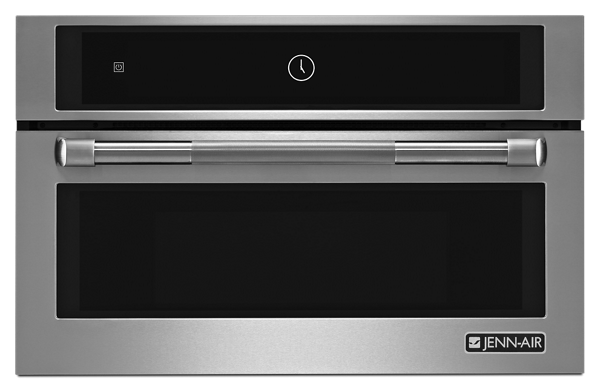
If your JennAir built-in microwave runs but does not heat food, the magnetron or related components may be at fault. Learn what to check and when to call for service.
How a Microwave Generates Heat
JennAir built-in microwaves — whether standalone units or speed oven combinations — use a magnetron tube to convert electrical energy into microwave radiation. The magnetron requires high voltage supplied by a transformer and capacitor circuit. If any component in this chain fails, the microwave may appear to operate normally (the turntable spins, the light turns on, the timer counts down) but food will not heat.
Safety Warning
The high-voltage capacitor inside a microwave can retain a lethal charge even when the unit is unplugged. Do not remove the microwave cover or attempt to access internal components unless you are a trained appliance technician with the proper discharge tools. The troubleshooting steps below focus on external checks that are safe for homeowners.
Step 1: Verify the Problem
- Place a microwave-safe cup filled with 8 ounces of water in the center of the turntable.
- Run the microwave at full power for 60 seconds.
- Carefully check the water temperature. If the water is not warm, the microwave is not generating microwave energy.
- If the water is warm but food items are not heating evenly, the issue may be a faulty turntable motor or stirrer fan rather than a heating failure.
Step 2: Check the Door Switches
Microwave ovens have multiple door interlock switches that must all be engaged for the magnetron to receive power. If the door does not close firmly or the latch mechanism is worn:
- Inspect the door for alignment — it should close flush without gaps.
- Check the door latch hooks for damage or deformation.
- Clean the latch receiver area inside the microwave frame — debris can prevent the switches from engaging.
- If a door switch has failed, the microwave may run (lights and fan) but the magnetron will not activate. This is a common failure point.
Step 3: Check Power Supply
- Verify the microwave is receiving full voltage. A JennAir built-in microwave requires a dedicated 120V, 20-amp circuit. If other appliances share the circuit, voltage drops under load can prevent the magnetron from operating.
- Check the outlet or hardwired connection. If the microwave is on a dedicated circuit with a GFCI outlet, the GFCI may have tripped — press the reset button.
Likely Internal Causes
If the external checks above do not reveal the problem, the issue is internal and requires professional repair:
- Failed magnetron — the most common cause of a microwave that runs but does not heat. Magnetrons fail over time and are not repairable — the part must be replaced.
- Failed diode — the high-voltage diode converts AC to DC for the magnetron. A failed diode produces no heat and sometimes a loud buzzing sound.
- Failed capacitor — works with the diode and transformer to deliver high voltage. A failed capacitor can also prevent heating.
- Failed transformer — less common, but a failed high-voltage transformer will prevent the entire magnetron circuit from operating.
Repair vs. Replace
For JennAir built-in microwaves, magnetron replacement is typically worthwhile if the unit is less than 8 to 10 years old. Parts cost between $100 and $250 plus labor. For older units, compare the repair cost against a new JennAir built-in microwave, considering that newer models may also offer improved features and efficiency.