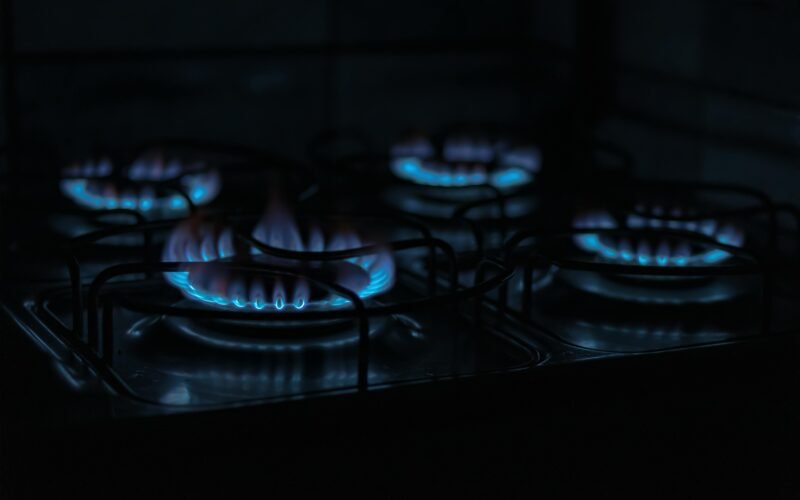
JennAir gas cooktops with brass burners offer exceptional heat output. If a burner won’t light, has a yellow flame, or produces uneven heat, follow these diagnostic steps.
JennAir Gas Cooktop Burner Design
JennAir gas cooktops feature stacked brass burners that range from a precision simmer burner rated at approximately 5,000 BTU to a high-output power burner rated at up to 20,000 BTU. The brass construction provides superior heat distribution compared to stamped aluminum burners. Each burner consists of a base, a burner cap, and a spark electrode. Understanding these components helps with troubleshooting.
Issue: Burner Won’t Ignite
If you hear clicking but the burner does not light:
- Check the burner cap — lift the cap and reseat it. It must sit perfectly flat and centered on the burner base. Even a slight misalignment directs gas away from the spark electrode.
- Clean the electrode — the spark electrode is the small white ceramic post next to the burner. Use a dry toothbrush to remove food residue or grease from the electrode tip. Do not use water or cleaning sprays directly on the electrode.
- Clear the burner ports — use a straight pin to clear each small hole around the perimeter of the burner cap. Clogged ports are the most common cause of ignition failure.
- Check for moisture — if you recently cleaned the cooktop, residual moisture around the burner prevents ignition. Dry the area thoroughly and wait 30 minutes before trying again.
Issue: Yellow or Orange Flame
A healthy gas burner flame should be predominantly blue with small yellow tips. A fully yellow or orange flame indicates incomplete combustion:
- Air shutter adjustment — some JennAir gas cooktops have an adjustable air shutter on each burner. If the air-to-gas mixture is too rich (not enough air), the flame turns yellow. Consult the installation manual for the air shutter location and adjustment procedure.
- Clogged burner ports — partially blocked ports restrict airflow into the flame, causing discoloration.
- Wrong gas type — JennAir cooktops are configured for natural gas by default. If your home uses LP/propane, the cooktop must be converted with the LP conversion kit. Using the wrong gas type causes yellow flames, soot, and poor performance.
Issue: Uneven Flame
If the flame is higher on one side of the burner than the other:
- Remove the burner cap and inspect for debris or grease deposits
- Clean all ports thoroughly
- Reseat the cap and verify it is level — place a small bubble level on the cap to check
- If the burner base itself is warped or damaged (rare with brass), the burner assembly may need replacement
Issue: Burner Won’t Turn Down to Simmer
If a burner maintains a high flame and will not reduce when you turn the knob toward the low setting, the gas valve behind the knob may be faulty or the knob may not be properly engaging the valve stem. Turn off the burner, pull the knob off, and inspect the valve stem for damage. If the stem is intact and the knob fits properly, the gas valve likely needs replacement — this is a technician-level repair.
When to Call a Technician
If you smell gas when all burners are off, or if gas continues to flow after a burner is turned off, shut off the gas supply to the cooktop immediately and contact a service professional. Gas leaks are a safety hazard that requires immediate professional attention.