
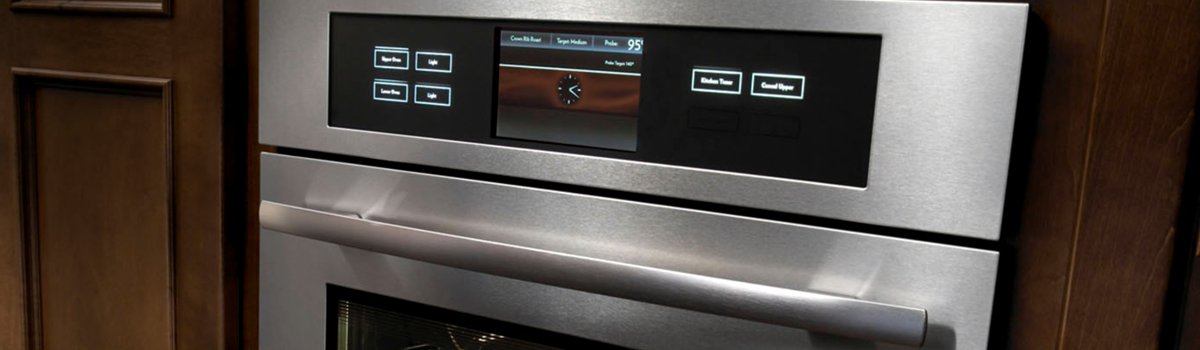
If your JennAir oven or cooktop flashes F6, the control has detected an Analog/Digital Mismatch—in plain English, the parts of the main control board that read signals (analog) and the parts that make decisions (digital/microcontroller) aren’t talking correctly. Sometimes this is a quick, recoverable glitch; other times it points to a failing control board, a noisy/unstable power supply, or a loose/contaminated ribbon cable. Either way, don’t ignore it: the same fault that throws F6 can also cause erratic preheats, random beeping, or unresponsive keys.
What the fault actually is
At the heart of modern ovens, the board samples sensors and inputs (like temperature probes, door switch, key matrix) as analog voltages, then converts them (A/D conversion) so the microcontroller can act (turning relays on, updating the display, regulating temperature).
F6 = the board can’t trust that pipeline. The mismatch may be momentary (electrical noise) or persistent (component failure).
Common symptoms
- Random F6 during preheat or when you touch several keys in a row
- Beeping or frozen display; oven won’t start or cancels a cycle
- Preheat stalls or overshoots; fans/relays click in odd patterns
Likely causes (in order of “most fixable” to “board may be bad”)
- Power quality issues: brief brownouts, shared circuits, or loose neutral can confuse the control
- Loose/oxidized connectors: UI ribbon or harness partially unseated; light corrosion from kitchen humidity
- Liquid or cleaner intrusion: steam/condensation behind the panel after a heavy boil or aggressive spray cleaner
- Electrical noise: failing igniter (on gas), arcing at a terminal, or a tired line filter introducing spikes
DIY: smart, safe steps before calling a pro
(Read fully, then proceed. If anything feels out of your depth, skip to the pro section.)
1) Do a clean power reset
Unplug the range or switch off the dedicated breaker for 5–10 minutes. This fully discharges the control and clears transient logic errors.
After restoring power, set the time and run a short Bake at 350°F. If F6 does not reappear after a few on/off cycles, it may have been a one-off power event.
2) Verify the circuit (quick checks)
- The range should be on a dedicated circuit (no disposals/microwaves sharing).
- For electric models, confirm both L1 and L2 are present at the terminal block (a lost leg can trigger faults and weird behavior).
- For gas models, make sure the igniter circuit isn’t chattering (audible rapid clicking when it shouldn’t).
3) Inspect the control panel area (no deep tear-down)
Kill power. Remove only the access panel needed to view the control and UI ribbon cable (refer to your user/installation guide for the safe panel to remove).
Look for:
- Connectors that aren’t fully seated
- Moisture residue or sticky cleaner film on the ribbon and headers
- Discoloration or burnt smell around the board
If you see light oxidation, reseat the ribbon: gently unplug, wait 10 seconds, plug back in squarely. Do not scrape contacts.
4) Re-create the scenario
Restore power and try the same sequence that caused F6 (e.g., selecting Bake + Temp + Start). If F6 returns immediately, the problem is persistent and likely board-related or harness-related, not a one-time glitch.
What you should not do
- Don’t spray cleaner into the control bezel; apply to a cloth first.
- Don’t keep cycling the breaker repeatedly if F6 returns right away; this can stress relays and the power supply.
- Don’t run a self-clean cycle while the control is suspect—heat and current draw can finish off a marginal board.
Preventive habits that actually work
Keep power clean
- Use a dedicated circuit; if your home sees frequent sags/spikes, consider a whole-home surge protector.
- Avoid running high-draw appliances on the same line if the circuit isn’t sized for it.
Protect the control from moisture
- After heavy boiling or a steamy roast, leave the door closed for a minute before opening fully to reduce a steam rush into the panel.
- Spray cleaners onto a cloth, not the fascia.
Gentle with the keypad
- Firm, brief presses beat repeated staccato taps that can confuse older key matrices.
Be cautious with self-clean
- If you must run it, do so in cooler seasons and only when the oven is otherwise healthy. Heat + long duration stresses electronics.
Quick reference: F6 checklist (one short list, then you’re done)
- Power reset 5–10 min → test Bake at 350°F
- Confirm dedicated circuit & proper voltage
- Kill power → reseat UI ribbon/harness → look for moisture/corrosion
- If F6 returns → schedule pro diagnosis; likely control or harness at fault
F6 is the control’s way of saying “I can’t trust my own readings.” Sometimes the fix is simple—clean power and a reseated ribbon. When it isn’t, moving quickly protects the board, relays, and your time. If you’d like it handled end-to-end, our certified team can get you back to predictable preheats and precise cooking.