
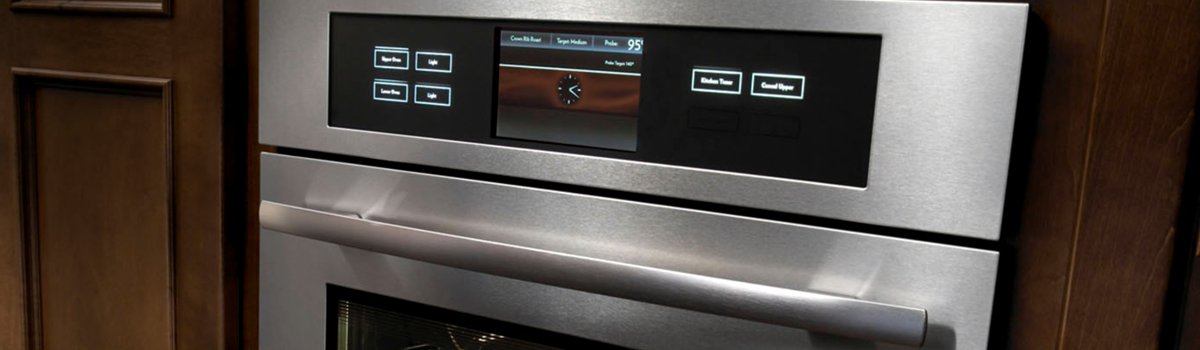
If your Jenn-Air shows FP during or after a self-clean, it’s usually the control telling you the self-clean cycle didn’t complete safely. In real-world service calls, that most often traces back to the door-lock system (latch motor or switch feedback) or a heating circuit that couldn’t ramp or cool the way the control expected. The good news: you can try a few safe checks before calling for service.
What “FP” Usually Means (in plain English)
Self-clean drives temperatures far higher than normal baking. To protect you and the appliance, the control must lock the door, monitor temperature rise, and confirm a safe cool-down. If any of those steps don’t look right—door never locks, a switch doesn’t report “locked,” heat stalls, or cool-down timing is off—the control flags an FP fault to stop the cycle.
You’ll often notice one or more of these:
- The door won’t unlock after self-clean, or it never locked in the first place
- Self-clean starts, hums or clicks, then shuts down with a beep and FP
- Long preheat, unusual smells, or the oven stays too hot too long after canceling
Why It Happens
Most FP faults boil down to either door-lock feedback or heat/airflow behavior not matching what the control expects. Think: a latch motor that moves but the switch never says “locked,” a bent striker that doesn’t let the switch close, a failed high-limit or thermal fuse opening mid-cycle, a weak bake/broil element, or wiring/connectors that expanded with heat and lost contact.
A few common triggers:
- Moisture or cleaner residue around the latch area after a heavy clean
- Worn latch motor or misaligned latch/striker so the switch never changes state
- Failed or weak bake/broil element causing slow temperature rise
- Open high-limit thermostat or thermal fuse tripping under extreme heat
- Loose harness connections at the lock assembly or control board
Try These Safe DIY Steps First
Unplug the range or switch the breaker off before touching anything inside. Give the oven time to cool fully.
Power reset
Turn the breaker off for 5–10 minutes, then back on. This clears a stuck state and lets the control recheck the lock position.
Check the door latch and striker
Open the door and inspect the latch opening at the oven frame and the door’s metal striker tongue. Look for bent metal, debris, or dried cleaner residue. Wipe the area and make sure the door closes cleanly and firmly.
Listen and observe on start
Start a normal bake (not self-clean). You should hear the control relays click and, on some models, the lock motor briefly test. If the door-lock light stays on when not in self-clean, the switch might be stuck.
Elements: quick visual
With power off, remove racks and look for breaks, blisters, or burn marks on the bake and broil elements. Any visible damage calls for replacement—not continued testing.
Temperature sensor sanity check (optional for the handy)
Most Whirlpool/Jenn-Air family ovens use an NTC sensor that reads about ~1kΩ at room temperature (roughly 1000–1100 Ω at ~70°F). If you have a multimeter and feel comfortable, test at the harness with power off. A reading wildly out of range suggests a sensor or harness fault.
If FP returns immediately after a reset or the door won’t unlock, stop here—forcing cycles can overheat components.
What a Technician Will Do
A pro will run the unit in diagnostic mode, meter the lock motor, lock/unlock switch continuity, and verify relay outputs to the elements. They’ll check the high-limit/thermal fuse, confirm sensor values, and inspect the control board connectors for heat-stressed pins. If alignment is the culprit, a simple latch/striker adjustment fixes it; if not, the common repairs are a latch motor/switch assembly, a temperature sensor, a failed element, or (less often) a control board.
Quick Fixes You Can Try (Summarized)
- Power-cycle at the breaker 5–10 minutes
- Clean and realign the latch/striker area, then test a normal bake
- Visually check elements; replace if cracked or blistered
- If the door is locked: after full cool-down, try a power reset; if still locked, a tech can safely release it from the top panel and address the failed part
How to Prevent FP Next Time
Keep self-clean safe and drama-free with a few habits that matter more than you’d think.
- Use self-clean sparingly
High heat is tough on locks, sensors, glass, and finishes. Spot-clean regularly and reserve self-clean for heavy build-up. - Prep before you self-clean
Wipe up spills, remove heavy splatter, and take out racks, probes, and foil. Excess residue smokes, overheats, and stresses components. - Mind the latch
Don’t slam the door, and avoid spraying cleaner into the latch opening. A small misalignment can keep the lock switch from signaling correctly. - Ventilation and airflow
Make sure the range has the clearances your install guide calls for, and use your hood during and after self-clean to help cool-down. - Annual checkup
A quick inspection can catch a sticky lock motor, weak element, or sensor drift before a self-clean cycle exposes it.
FAQs (Fast Answers)
Can I cook with FP showing?
Avoid using the oven until the fault is cleared; the control flagged a safety-related condition tied to self-clean.
How do I unlock the door if it’s stuck?
Let it cool completely and try a power reset. If it stays locked, a technician can release it safely from the top and replace the failed lock or switch.
Is a control board always required?
No. Many FP calls are resolved with a latch/switch assembly or element fix. Boards are replaced only when diagnostics show failed outputs or corrupted logic.
Want me to tailor this for your exact Jenn-Air model (so the sensor values, part numbers, and menu steps match your control panel)? Send the model + serial, and I’ll customize it line-by-line.