
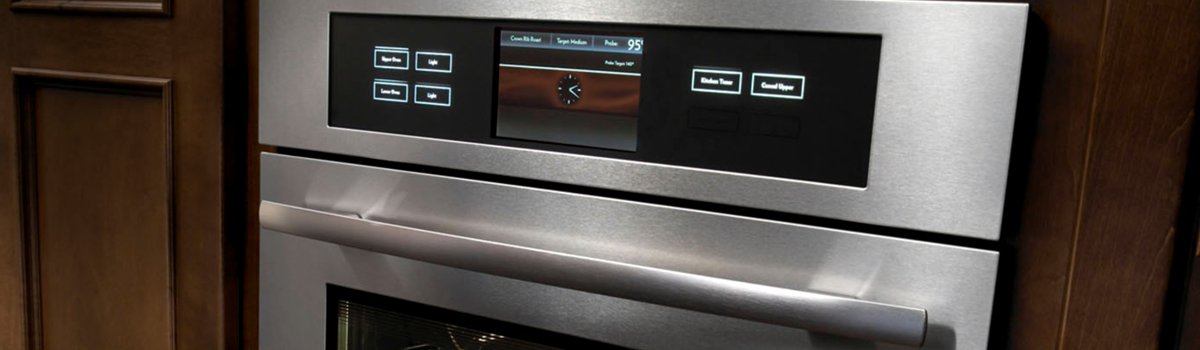
When your Jenn-Air flashes FJ, it’s calling out a convection fan problem—the fan that moves hot air around the cavity so foods bake evenly. Without that airflow, preheats take longer, edges overbrown while centers lag behind, and the oven may shut down mid-cycle to protect itself.
What this malfunction actually means
In plain terms, the control isn’t seeing the convection fan behave as expected. That can be a fan motor that won’t start or spins slowly, a blocked blade, a wiring/connector fault, or a control output that isn’t delivering proper power. Heat builds up around the fan area, airflow stalls, and the oven throws FJ to prevent damage.
How it shows up in everyday cooking
You’ll notice one or more of these before or alongside the code:
- Longer-than-normal preheat, then uneven results on multi-rack bakes.
- A quiet cavity when Convection Bake/ Roast should be moving air (normally you’ll hear a soft whoosh).
- Intermittent shut-offs or a code that appears after 10–20 minutes at temperature.
DIY first steps (safe and simple)
Unplug the range or switch off the breaker before you touch anything.
Check the fan area for obstructions.
Remove racks. If your model exposes the fan cover with a few screws, take it off and look for a loose foil, warped parchment, or a bent baffle rubbing the blade. Gently spin the blade by hand; it should coast freely without scraping.
Clean light debris.
Vacuum crumbs and wipe grease mist around the shroud. Built-up residue can drag on the blade and warm the motor.
Reseat accessible connectors.
If your model allows rear access to the fan harness, ensure the plug is fully seated and not heat-discolored. Restore power and test Convection Bake at a moderate temp (e.g., 325°F). Listen for the fan.
If FJ returns immediately or the fan doesn’t spin, move to the fixes below or schedule service—running without airflow can overheat components.
Common causes (and how to think about each)
Worn or seized convection fan motor
Bearings dry out over time; the motor draws high current, starts slow, or stalls hot. If the blade feels gritty or won’t free-spin, the motor is near the end of its life.
Blade damage or misalignment
A bent blade or out-of-shape shroud scrapes at temperature. You’ll hear cyclical rubbing that worsens as metal expands.
Grease/crumb build-up behind the cover
Even a thin film increases drag and heat. After cleaning, performance often snaps back—until residue builds again.
Loose, heat-stressed wiring
Repeated thermal cycles can loosen spades or cook a connector. Any browning/melting is a red flag—replace, don’t reuse.
Control (relay/triac) failure
If a known-good fan won’t receive power during a convection mode, the control output may be the culprit. This needs a meter and experience to confirm.
Owner-level fixes you can try
Keep it straightforward and safe—no disassembly beyond covers the manual shows.
- Power reset: After inspections, kill power for 5 minutes, restore, and retry a convection mode. Transient faults sometimes clear, but repeat FJ means a real issue.
- Deep clean the shroud area: With the cover off (where the manual permits), degrease the shroud and wipe the blade. Avoid bending vanes.
- Recenter the fan cover: If the shroud touched the blade, loosen screws, center it, and retighten evenly.
- Temperature test: Run Convection Bake at 300–325°F. You should hear air movement within a minute, not just element humming.
If the fan still won’t spin—or spins noisy/slow—the motor assembly likely needs replacement. That’s a routine repair for a pro.
Preventive habits that keep FJ away
Keep it practical—no special tools needed.
- Vent and cool-down: After high-temp roasts or self-clean (if your model supports it), crack the door a touch when off to let heat escape. Less heat soak = happier motor and connectors.
- Quarterly clean behind the fan cover (if manual allows): Light degrease of the shroud and a vacuum around the blade.
- Skip floppy liners: Loose foil or oversized parchment can get sucked into the shroud—use rigid sheets that fit the rack.
- Watch for early signs: A faint scrape, longer preheat, or uneven bakes on two racks are early clues. Fixing drag now is cheaper than replacing a cooked motor later.
Quick reference — your action plan
- Power off → inspect → clean → re-center cover → power on → test Convection Bake.
- If the fan is still silent, slow, or noisy: replace the convection fan assembly and inspect wiring; have a pro confirm control output.
Want it fixed without guesswork? Our factory-certified oven specialists handle Jenn-Air daily and carry OEM parts for clean, lasting repairs.