
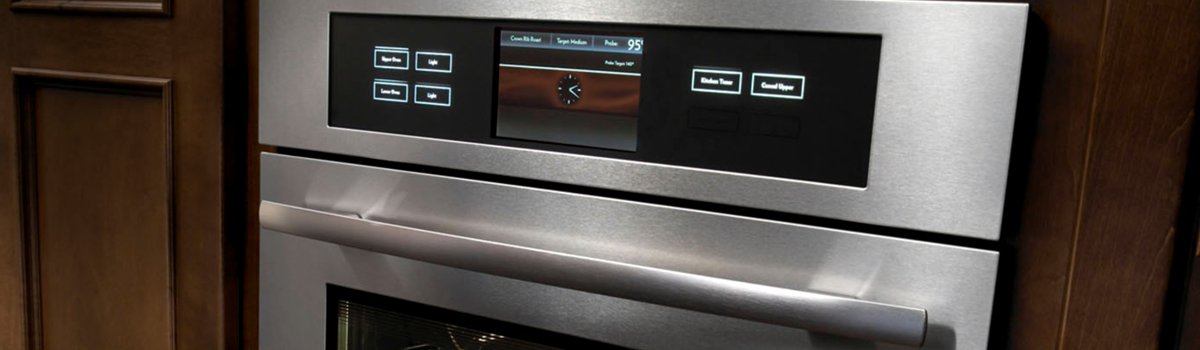
When your Jenn-Air oven flashes FE, it’s pointing to an EEPROM error—basically a problem with the tiny memory chip on the control board that stores settings and operating logic. Think of it like your oven’s “brain note pad.” If that memory is corrupted or unreadable, the control can’t manage heat or safety routines correctly.
What “FE / EEPROM Error” Really Means
In plain English: the control board tried to read its saved data and got nonsense back. That can happen after a power surge, a brownout, a control-board fault, or even moisture/heat stress during heavy cooking or a self-clean cycle.
Typical signs you’ll notice:
- The oven won’t start a bake or stops mid-cycle.
- The display shows FE right after power-up.
- Unresponsive keys, random beeps, or the clock resets.
- Inconsistent preheats or sudden shutdowns.
Electrical events
Brief power spikes, brownouts, or flickers can corrupt stored data.
Aging or failing control board
Over time, components on the electronic control can drift or fail, especially after repeated high-heat events.
Moisture/heat intrusion
Steam from pots or the extreme temps of a self-clean can stress electronics if vents are blocked or cooling fans are impaired.
Loose or oxidized connections
A half-seated ribbon cable between the touchpad/UX panel and the control board can trigger memory-read errors.
Quick Safety Note
Before any hands-on steps, turn the range/oven off at the breaker. Electronics inside carry line voltage and have sharp sheet metal. If you’re not comfortable, skip to the “Call a Pro” section.
DIY First Aid (Start Simple, Then Go Deeper)
1) Power Reset (5–10 minutes)
Unplug the unit or switch OFF the breaker for 5–10 minutes. This fully discharges the control and clears transient faults. Turn power back on and see if FE returns during a normal Bake test.
If FE disappears:
Great—monitor the next few cooks. If it returns, keep reading.
2) Check Venting & Cooling (No Tools)
Open the cabinet area and make sure upper control vent slots aren’t blocked by trim or stacked items. Run the oven fan/cooling cycle if your model has one. Overheated electronics are a common trigger for intermittent FE.
Good practice: Leave a few inches of clearance around control vents, and avoid draping towels over the control panel.
3) Inspect the Touchpad Ribbon / Harness (Basic Tools)
With power OFF, remove the control panel/back cover as your model allows. You’re looking for:
- A flat ribbon cable that connects the touchpad/user interface to the main control.
- Fully seated connectors (no tilt, no half-in).
- Corrosion or discoloration on pins.
Gently reseat the ribbon once or twice to burnish the contacts. If you use any cleaner, stick to a lint-free swab lightly moistened with isopropyl alcohol (and let it dry completely). Restore power and test again.
4) Factory-Style Reset / Diagnostics (If Available)
Some Jenn-Air models allow a key-sequence to enter diagnostics and clear stored faults. If your user manual lists a service/diagnostic mode, try it now. If not, don’t guess—the wrong sequence may do nothing or confuse the control.
5) When the Control Board Is the Culprit
If FE returns immediately after a clean reset and connector check, the electronic control board (clock/relay board) likely needs replacement.
What to know before replacing:
- Programming codes (“personality codes”) may be required after installation. These are usually on the tech sheet inside the unit or on the new board’s label.
- Static-safe handling helps: touch metal to discharge before touching the board; avoid handling pins.
- Take clear photos of every connector before you unplug anything so reassembly is foolproof.
If that sounds like a lot, it is—this is where most homeowners choose a professional.
Can I Keep Using the Oven with FE Showing?
Short answer: don’t. If the control can’t reliably read its memory, it can’t guarantee temperature control or safety routines (door lock, over-temp, etc.). Power it down, try the resets above, and book service if the code returns.
Preventing FE (And Other Control Issues) Long-Term
Use surge protection.
A whole-home surge protector or a high-quality line protector for the circuit can save control boards from power spikes.
Skip frequent self-clean cycles.
Self-clean pushes internal temps to extremes. If you must use it, verify vents are clear and give electronics time to cool afterward.
Keep vents clear.
Don’t block the control panel’s ventilation slots. Make sure the cooling fan (if equipped) runs and exhaust paths aren’t obstructed.
Mind moisture.
Boiling pots directly under the control panel drive steam upward. Use the vent hood and avoid letting condensation soak the UI area.
Stable power-up/down.
Avoid flipping breakers rapidly or running the oven during major electrical work. Let the control fully power down before restoring power.
Quick Reference — What You Can Do vs. What a Pro Should Do
Good DIY bets (safe, low-risk):
- Full power reset for 5–10 minutes.
- Vent/clearance check around the control panel.
- Visual inspection and reseat of the touchpad ribbon (power off, gentle).
Pro territory (tools, parts, programming):
- Running diagnostics and checking error history.
- Board replacement and entering the correct programming code.
- Verifying voltage quality, ground, and neutral integrity at the terminal block.
- Heat-load checks after repair to confirm stable temps across modes (Bake/Broil/Convection).
FE means your Jenn-Air’s control memory can’t be read reliably. Start with a clean power reset and a quick connector/vent check. If the code returns, the control board likely needs service or replacement—and programming to your exact model. Handle it promptly to avoid on-again/off-again cooking and potential safety shutoffs.
If you’d rather skip the trial-and-error, our factory-certified range/oven techs can diagnose FE fast and install the right OEM board.