
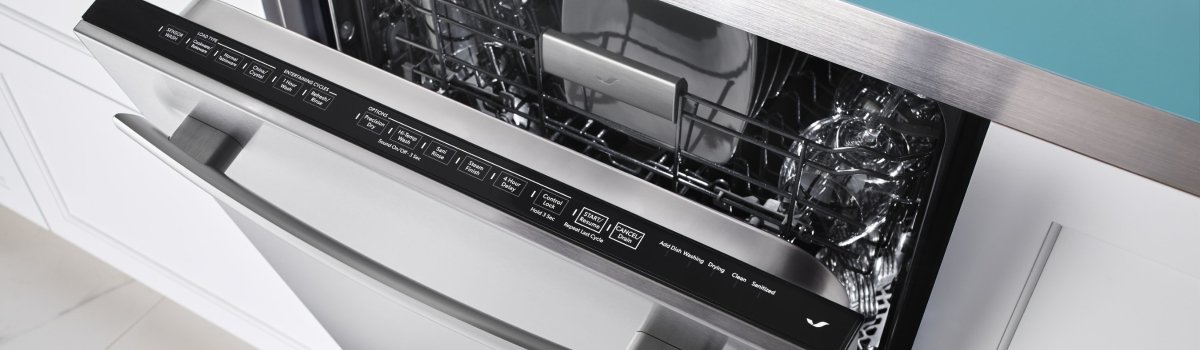
When a Jenn-Air dishwasher throws Error Code FT, it’s calling out a spray-arm problem. In plain English: the arm that should spin and fling water across the racks isn’t rotating like it should. That kills coverage, leaves grit on glasses, and can make a brand-new detergent tab feel useless. The good news? FT is often fixable with careful cleaning and a few simple checks—no special tools required.
What this fault actually means
Your dishwasher relies on stable water pressure and a low-friction pivot to spin the spray arm. If debris clogs the jets, if the arm is jammed by a tall pan or utensil, or if the bearing/bushing is gunked up, rotation slows or stops. The control senses poor circulation and flags FT. Sometimes the root cause isn’t the arm itself—it can be low fill level from a supply issue, or a partially clogged filter starving the pump.
Real-world symptoms (before or alongside FT)
- Dishes on the top rack come out sandy or with dried sauce shadows
- Standing water beads on cups even after a heated dry
- You hear the pump humming but not the rhythmic whoosh of a spinning arm
- The arm feels stiff when you try to turn it gently by hand (power off first)
DIY fix you can try right now
Start with safety: power off the dishwasher at the breaker or unplug it. Let hot parts cool.
- Clear the load path
Pull out racks and check for anything tall that could block rotation—spatulas poking through the rack, a pot handle, a straw lodged in the arm path. Re-rack so the arm has a clean 360° sweep. - Remove the spray arm
Most Jenn-Air arms either unclip or twist-lock off a center hub. Lift straight down (lower arm) or up (upper arm) depending on your model. If unsure, take a photo first. - Flush the jets
Run warm water backwards through the arm to push debris out of the nozzles. Use a wooden toothpick to loosen mineral grit—don’t enlarge the jet holes with a metal pick. Shake and flush until water runs free from every port. - Clean the hub/bearing
Wipe the hub and mating surfaces. If there’s chalky limescale, soak the arm end in a 1:1 warm white-vinegar solution for 10–15 minutes, then rinse. Spin the arm in your hand; it should coast smoothly. - Check the filter & sump screen
Lift the bottom filter assembly and rinse it thoroughly. A clogged filter restricts flow and will trigger poor spray even with a spotless arm. - Reassemble & test
Refit the arm (listen for a positive click/lock). Restore power. Run a quick rinse cycle and open mid-cycle (carefully) to confirm the arm has changed position—close and let it finish.
If FT returns immediately or the arm still feels sticky, move to the next checks.
If the error persists: what else to rule out
A couple of underlying issues can mimic a spray-arm fault. Work through them in this order:
- Low water level: Start a cycle, then pause after fill. Water should sit just below the filter screen. If it’s low, confirm the supply valve is fully open and the inlet screen (at the hose connection) isn’t clogged.
- Weak wash pump or blocked diverter: If the pump is noisy or you find plastic label fragments in the sump, the pump/impeller may be obstructed.
- Cracked arm or worn bushing: Hairline cracks bleed pressure and stop rotation. Replace the arm if you see splits or a loose, wobbly hub.
- Detergent and water hardness: Heavy mineral content builds scale on jets and bearings. If you regularly see white film, consider a rinse aid and (if your model supports it) adjust the built-in water-softening setting.
When to call a pro (and why)
If the arm is clean and free, water level is correct, and FT still returns, you’re likely looking at diverter valve, wash-motor performance, or a sensor/control logic issue. A technician can measure current draw, check diverter indexing, and verify pressure/flow under load—fast and without guesswork. Running repeated cycles with poor circulation can overwork the pump and bake food soils onto heater elements, so don’t let it drag on.
Smart habits that prevent FT in the first place
Keep it simple. A few small changes keep spray arms happy and spinning:
- Load for line-of-sight: Face dirty surfaces toward the arm, avoid nesting bowls, and keep tall items away from the arm’s circle.
- Scrape, don’t rinse to bone-dry: A little moisture helps detergent activate; big chunks, however, will clog filters and jets.
- Rinse the filter weekly: It’s a 60-second job that saves your pump and preserves pressure.
- Mind water quality: Hard water? Use rinse aid consistently and consider a periodic descale with a dishwasher cleaner.
- Use the right cycle: Heavily soiled pots need a heavier program to maintain spray pressure and time on target.
Need help finishing the job? Our factory-certified dishwasher specialists can run circulation tests, replace a worn arm, or service the diverter/pump with OEM parts—often same-day in many areas.