
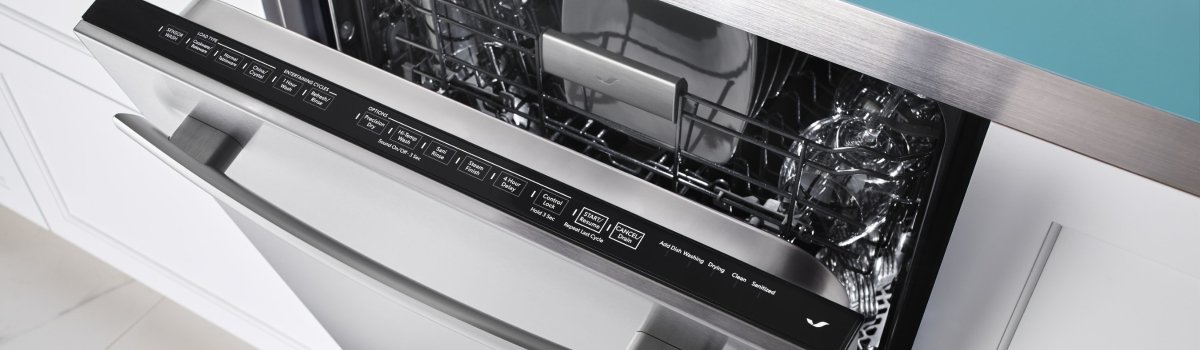
When your Jenn-Air dishwasher flashes Error Code FR, it’s calling out a water hardness sensor issue. That sensor helps the machine “tune” wash performance for your local water—and when it misreads or drops offline, you can see dull glassware, residue on dishes, longer cycles, or the FR code halting a run. The good news: most fixes are simple and safe to try before you call for service.
What FR Actually Means (in plain English)
Your dishwasher is trying to measure how “hard” your water is so it can dose and time the wash properly. FR appears when the control isn’t getting a believable signal from the hardness sensor (sometimes integrated with the flow/turbidity assembly). The control then plays it safe, flags the fault, and may end the cycle to avoid wasting water or leaving detergent behind.
Hard water isn’t a disaster, but the wrong hardness reading can lead to cloudy films, gritty residue, or poor drying—because the unit can’t optimize wash chemistry.
Why It Happens
Several everyday things can confuse or disable the sensor:
- Scale and film on the sensor window from mineral deposits.
- Detergent buildup or food fines swirling past the sensor and sticking.
- Low or irregular water flow from a partly closed supply valve or kinked inlet hose.
- Wiring/connector issues at the sensor harness or the control.
- A truly failed sensor module, much less common than buildup but possible—especially in very hard water areas.
First Steps (Quick and Safe)
Unplug the dishwasher or switch off the breaker before you touch anything.
- Power reset: After 5–10 minutes, restore power and try a normal cycle. Temporary glitches can clear.
- Check water supply: The under-sink valve should be fully open; the inlet hose shouldn’t be kinked.
- Rinse-aid on: Verify rinse-aid isn’t empty; it dramatically improves hard-water results.
If FR returns quickly, go a bit deeper.
DIY Fixes You Can Try (No special tools)
Work methodically; you’re aiming to restore a clean, steady reading at the sensor.
Clean the filter and sump
Remove the lower rack and filter. Rinse the filter under warm water and brush away fines and gelled detergent. A clogged filter re-circulates debris that can coat the sensor window.
Descale the sensor area (no harsh chemicals)
With the dishwasher empty, pour 2 cups of plain white vinegar into the tub and run a short hot cycle. For heavy scale, pause mid-cycle for 20 minutes to let vinegar sit. This dissolves the mineral film that blocks the sensor’s “view.”
Run a detergent-free hot cycle
After descaling, run one hot cycle without detergent to flush loosened residue. Then try a normal cycle and watch for the FR code.
Inspect and reseat the sensor connector
With power off, remove the toe-kick panel. Find the harness leading to the sensor/flow assembly (usually on the side or base). Gently unplug and reseat the connector—look for moisture, corrosion, or a loose latch. If pins are green or chalky, note it for a tech.
Confirm detergent and loading
Use a fresh, high-quality detergent (old pods absorb moisture and clump), avoid nesting bowls that block spray, and don’t overfill the silverware basket—restricted spray can mimic “bad” hardness readings.
How to Tell You Fixed It
Two or three clean cycles without FR (and visibly better rinse/dry) mean the sensor is reading again. Glassware should come out clear, not hazy. If the code recurs—especially early in the cycle—the control still isn’t getting a stable signal.
Prevention That Actually Works (Especially in Hard-Water Areas)
You don’t need complicated routines—just a few consistent habits:
- Monthly de-scale cycle
Run a hot cycle with a dishwasher-safe descaler or 2 cups of white vinegar (no dishes). This keeps the sensor window and spray paths clear. - Right detergent + rinse-aid
Use a reputable detergent (powder or fresh pods) and keep rinse-aid topped up. In hard water, these are non-negotiable for clear glass and sensor accuracy. - Airflow after cycles
Crack the door slightly after drying so steam escapes; this reduces mineral spotting and residue settling on the sensor. - Check the inlet screen
Every few months, inspect the water-inlet filter screen for sand or scale that can starve flow and confuse readings. - Whole-home softener (if needed)
If you live with very hard water, a softener dramatically cuts scale, extends appliance life, and keeps sensors clean. It’s a bigger investment that pays off in performance and fewer service calls.
Quick Action Plan (Bookmark This)
- Reset power → verify supply valve fully open → confirm rinse-aid.
- Clean filter and sump → run vinegar de-scale → flush with one hot cycle.
- Reseat sensor connector (power off) → test two complete cycles.
- If FR returns: schedule service for sensor/harness diagnostics and calibration.
Prefer to skip the guesswork? Our factory-certified dishwasher technicians handle Jenn-Air daily—brand-level diagnostics, correct parts, and careful installation.