
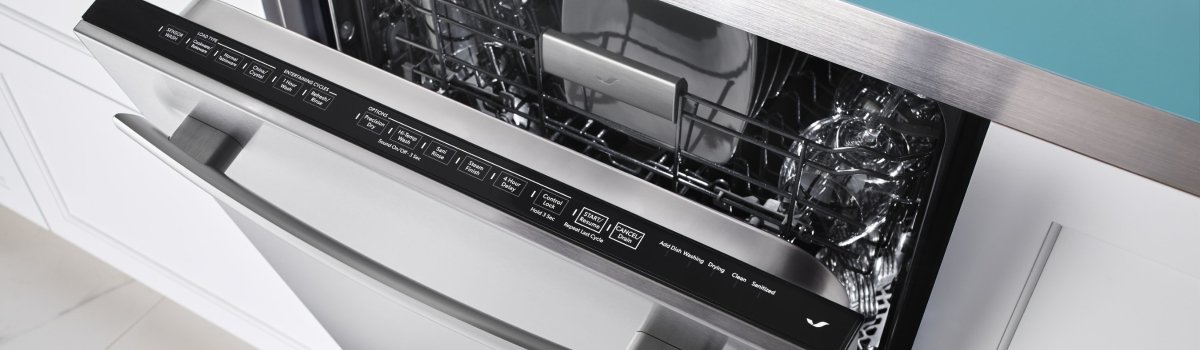
When your Jenn-Air dishwasher flashes Error Code FK, it’s calling out a thermistor issue. The thermistor (a temperature sensor) tells the control board how hot the wash water is. If it misreads—or stops reading altogether—the machine can’t manage heat for washing or drying, so cycles may stall, run forever, or end with dishes still wet.
What FK Really Means (in plain English)
Inside the tub assembly, an NTC thermistor changes resistance as the water warms. The control expects a certain resistance range for a given temperature. FK appears when readings are out of range (open/short circuit) or don’t change the way they should during a heat cycle. Sometimes the sensor is fine but its wiring harness or connector is oxidized, loose, or heat-damaged, which looks like a bad sensor to the control.
You might notice:
- Extra-long cycles, poor drying, or no heat at all
- The fan/vent acting oddly, then FK
- Cycle ends early with dishes cool to the touch
Why It Happens
Most FK cases trace back to one of three things:
- Failed thermistor (waterproof capsule loses integrity or ages out).
- Harness/connector fault (moisture in a plug, brittle insulation, or a loose pin).
- Heating/temperature logic conflict (heater never energizes or water enters too cold, so the temperature curve looks “wrong” to the control).
Safety First, Then a Simple Reset
Kill power at the breaker for 5 minutes, restore power, and rerun a normal cycle. If FK returns quickly—especially at the same point of the cycle—move on to inspection. Never work with the unit energized or with wet floors around open panels.
Smart DIY Steps (minimal tools, maximum signal)
- Confirm hot-water supply
Run the kitchen tap until it’s hot before starting a cycle. Aim for 120°F/49°C at the faucet; very cold inlet water can confuse heat-up timing. - Check for obvious wiring issues
With power off, remove the toe-kick. Use a flashlight to inspect the thermistor harness where it enters the sump area and routes up to the control. Look for a loose plug, green/white oxidation, or nicked insulation. Reseat any reachable connector once (firm, straight push). - Rinse-aid and vent sanity check
Poor drying doesn’t cause FK, but it travels with it. Make sure rinse-aid isn’t empty and that tall items aren’t blocking the vent outlet inside the door. - Try a controlled test
Start a Normal or Auto cycle with no dishes. Listen around the 10–20 minute mark: the machine should fill, wash, and then heat. If FK appears again at the same stage, the control still isn’t seeing temperature change—strong hint at the thermistor circuit.
If you have a multimeter and are comfortable using it: with power off and the harness unplugged, measure the thermistor resistance at room temperature (many NTCs read ~10kΩ–100kΩ depending on design). A reading of infinite (open) or near-zero (short) is a bad sensor or harness. If readings look plausible but fluctuate when you wiggle the harness, the connector is suspect.
When to Call a Pro
- FK returns immediately after a reset and a harness reseat
- Visible heat damage, corrosion, or water intrusion at connectors
- Heater never energizes (no warmth on inner door or tub during mid-cycle)
- You measured open/short across the sensor leads
A technician will confirm with live diagnostics, verify thermistor values across temperatures, load-test the heater circuit, and replace the thermistor or sub-harness with the correct part for your exact model.
Practical Fixes You Can Do (without over-disassembly)
- Reseat any accessible thermistor and control board plugs once; ensure they lock fully
- Dry damp connectors gently (room air or a hair dryer on cool) before reseating
- Re-route any wire that’s touching hot metal; use original clips/guides so it won’t chafe
- If you’re confident with crimps: replace a burned spade terminal with the proper high-temp, correct-gauge fitting
If FK keeps returning, stop cycling power and book service—repeated faulting can stress the board and heater relay.
Preventive Habits That Keep FK Away
Keep it simple and consistent, and your thermistor will live a long, boring life:
- Hot start: Run the sink hot first; starting at 120°F shortens heat-up time and keeps temperature curves “normal” to the control.
- Load for airflow: Don’t block the vent path with cutting boards or sheet pans along the door edge.
- Descale on schedule: Hard water leaves film on sensors and metal surfaces. Use a dishwasher cleaner or citric-acid cycle every 1–2 months.
- Fix small leaks fast: Any moisture in the toe-kick area can wick into connectors. If you ever see dampness, address it before it becomes corrosion.
- Gentle cleaning: Avoid blasting the door’s inner panel or control area with sprays; moisture can migrate into the harness plugs.
- Annual quick check: Pop the toe-kick, look for dust bunnies on fans/vents, and eyeball the harness routing—60 seconds, big payoff.
Prefer to skip the trial-and-error? Our factory-certified dishwasher specialists handle Jenn-Air daily—brand-level diagnostics, OEM parts, and, in many areas, same-day service.