
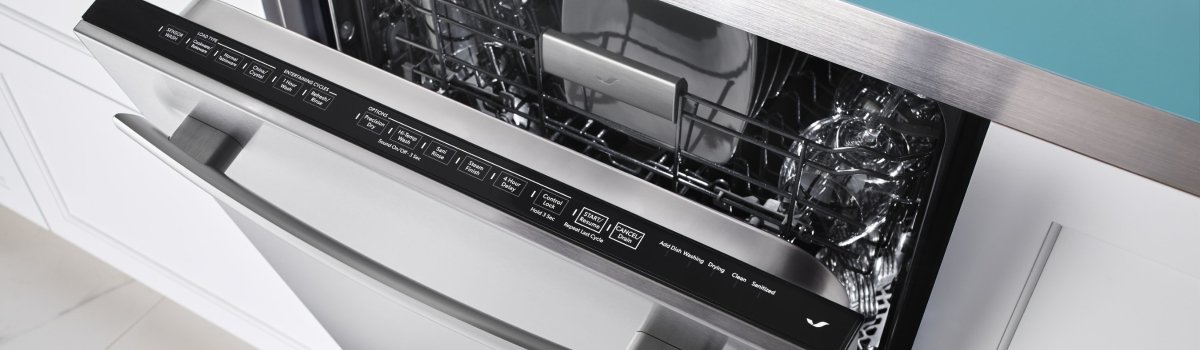
When your Jenn-Air dishwasher throws Error Code F9, it’s flagging a problem with the diverter valve—the part that routes wash water to different zones (lower spray arm, mid, upper). If the valve can’t move to the position the control expects, spray pressure drops where you need it, cycles stall, and the board logs F9.
What this fault really means
Inside the sump is a small motor/gear assembly that turns a valve disc. As the disc rotates, water is sent to specific spray arms in sequence. F9 appears when the control doesn’t see the diverter reach its target, or when feedback from the position sensor doesn’t make sense. Sometimes the motor is fine but grit in the sump jams the disc; other times a stripped gear, swollen seal, or corroded connector stops movement entirely.
You’ll often notice poor cleaning on one rack, oddly quiet spray sounds, or a cycle that seems to run forever before F9 shows up.
Common causes (in plain English)
- Debris in the sump: seeds, glass slivers, labels, or food pulp wedged around the diverter disc.
- Stuck or swollen diverter seal: heat and detergents can deform rubber over time.
- Worn gears or weak motor: the diverter motor can spin freely with no torque if a gear is stripped.
- Electrical trouble: loose/corroded connector at the motor or a damaged harness segment.
- Control logic mismatch (less common): the board isn’t reading the position sensor correctly.
First things first: quick checks (no tools)
Start with the basics before you open anything.
- Power reset
Turn the dishwasher off at the breaker for 5 minutes to clear a confused control state. Restart a normal cycle and listen: you should hear distinct changes in spray intensity as zones shift every few minutes. No change—and F9 returns—means the diverter likely isn’t moving. - Rack and filter sanity check
Confirm lower and upper spray arms spin freely and aren’t blocked. Remove and rinse the coarse filter and fine screen under the lower rack; heavy debris there is a clue the sump may be jammed.
DIY steps for careful homeowners
If you’re comfortable working safely around water and electricity, these steps can clear many F9 issues. Always cut power at the breaker before opening panels.
Step 1 — Access and clean the sump (light DIY)
Pull the lower rack and spray arm. Lift out the filter assembly and look into the sump. With a flashlight, check for seeds, glass, or labels. Use long tweezers to remove debris—don’t force anything deeper. Rinse the filter screens thoroughly and reinstall.
Step 2 — Inspect the diverter area (moderate DIY)
With power off, tip the unit slightly forward and remove the toe-kick to see the bottom. Identify the diverter motor on the underside of the sump (a small round motor with a harness plug). Gently reseat the connector; look for green/white corrosion or moisture. Restore power and start a cycle: if the valve now moves and F9 stays away, oxidation was likely the culprit.
Step 3 — Listening test
During the first 5–10 minutes of a cycle, place a hand lightly on the door: you should feel subtle changes as zones switch. Constant, unchanging spray sound often means a stuck diverter. If the motor buzzes or ticks but the sound never changes, the gear may be stripped.
If F9 returns after a full reset and cleaning—or you can see water seepage around the motor—stop DIY and book service. Running repeated cycles against a jammed diverter can overheat the motor and stress the control board.
When to call a pro (and what they’ll do)
A technician will pull ohm readings on the diverter motor, verify voltage from the control, and check the position sensor feedback during a service test. If the valve disc is swollen or gears are damaged, they’ll replace the diverter motor/assembly or the entire sump-and-motor module depending on model. If the motor tests good but it still won’t index, the control output or wiring harness is next on the list.
Practical fixes you can do without over-repairing
- Keep the filter screens spotless and reinstalled correctly after every deep clean.
- If a label or broken glass made it into the sump once, consider a mesh silverware basket liner to catch future shards.
- Reseat any easy-reach harness plugs you can access from the bottom panel (with power off).
- Avoid “forcing” the spray arms—bending them can create new problems unrelated to F9.
Prevention that actually works
Good habits beat repeat faults:
- Rinse away hard pits and labels from jars and produce—these are top offenders for sump jams.
- Use the right detergent and rinse aid per manual; overdosing creates heavy suds, which reduce pump load feedback and can confuse control logic.
- Run a monthly hot maintenance cycle (with a dishwasher cleaner) to flush grease and mineral fines out of the diverter cavity.
- Load for airflow and access: don’t let tall items block the lower spray path; the diverter has to move water where it’s asked to.
- Fix small leaks early: moisture around the diverter motor invites corrosion at the connector.
Quick action plan (bookmark this)
- Breaker off → wait 5 minutes → power on and retest.
- Clean filters; inspect the sump for debris.
- Reseat the diverter motor connector from the toe-kick area.
- If F9 returns or you hear no zone changes: schedule service for diverter motor/assembly or sump module evaluation.
Prefer to skip trial-and-error? Our factory-certified dishwasher techs can diagnose F9, replace the diverter assembly with OEM parts, and verify control operation so your Jenn-Air cleans like new.