
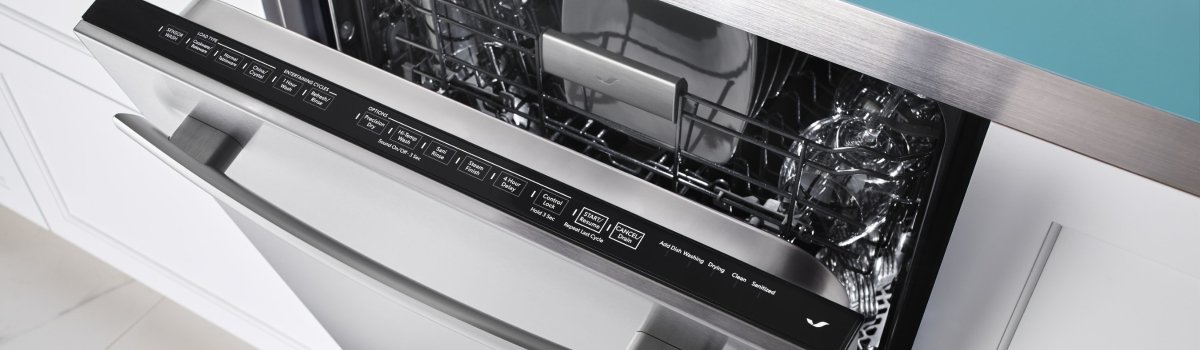
When your Jenn-Air dishwasher throws Error Code F7, it’s telling you the flow meter isn’t reporting water correctly. The flow meter is a small sensor that counts how much water enters the machine during fill. If it stops sending the right “pulses” to the control—or water can’t move like it should—the control halts the cycle and flags F7.
What this fault actually means
Inside the fill path, a tiny turbine spins as water flows. A sensor reads the spins and tells the control, “we’ve taken in enough water.” With F7, the control either sees too few pulses (not enough water, slow/blocked flow) or no pulses at all (failed sensor, wiring issue). You might notice longer-than-usual fills, a quiet machine that never starts washing, or a quick stop with F7 on the display.
Common causes (in plain English)
- Low or restricted water supply: closed or half-closed shutoff valve, kinked supply hose, clogged inlet screen.
- Mineral/debris build-up: the tiny turbine in the flow meter can gum up and stall.
- Wiring/connector problems: loose, corroded, or pinched harness between the meter and control.
- Bad flow meter: sensor or turbine has failed.
- Drain siphoning during fill: a poorly installed drain hose can pull water out while filling, confusing the sensor.
Quick safety check, then a clean reset
Unplug the dishwasher or switch the breaker off. Wait 5 minutes, restore power, and try a Normal cycle. If F7 reappears quickly, move on to the checks below—don’t keep restarting; you’ll just repeat the fault.
DIY: Smart checks before you buy parts
Start with the easy wins that fix most F7 calls.
- Make sure the dishwasher is getting water
Open the sink shutoff fully (handle parallel to the line). If you recently did plumbing work, some debris may have hit the screens. - Inspect the supply hose and inlet screen
Pull the toe-kick, follow the braided line to the inlet valve. With water off, disconnect the line at the valve and check the little screen inside the valve or hose fitting. Rinse or brush away grit; reattach carefully and turn water on.
Tip: if the hose feels kinked behind the cabinet, re-route it with a gentle arc. - Run a quick fill test
Start a cycle and listen at the start: you should hear a clean, steady fill for ~60–90 seconds (varies by model). If it dribbles, sputters, or stops early, supply is still restricted. - Look at the drain hose routing
Confirm you’ve got a high loop under the counter (or an air gap). If the hose drops to the floor before looping up, water can siphon out while filling—F7 guaranteed.
If these basics don’t clear F7, the issue is likely the flow meter assembly or its wiring.
A closer look at the flow meter (what you can check)
The meter is typically an inline plastic pod on/near the inlet valve, with a small two-wire connector. With power off:
- Reseat the connector to the meter and follow the harness as far as you can. Look for pinched wires or green/white corrosion on pins.
- If you’re comfortable, remove the meter and rinse the turbine under warm water. Mineral flakes can stall it; don’t pry or force it.
Restore power and test again. If F7 returns promptly—and you’ve verified good water flow—the meter may not be sending pulses.
When to replace the flow meter (and how to get the right one)
If cleaning/reseating didn’t help, replacement is straightforward for many models. Match by full model and serial to get the correct meter or inlet-valve-with-meter assembly (Jenn-Air is part of the Whirlpool family; part styles vary). Shut water off, lay a towel, swap the part, check for leaks, and test a quick cycle.
If you’re not comfortable opening panels or handling water/electrical connections, it’s perfectly okay to stop here and book a tech.
Signs you should call a pro
- F7 returns immediately after a successful basic fill check.
- You found brittle, heat-darkened, or pinched wiring.
- The machine fills normally but still flags F7 (points to signal issues: meter pulses or control input).
- You want a control-side diagnosis (tech will check pulse frequency from the meter, verify harness continuity, and rule out a board fault).
Keep F7 from coming back (simple prevention)
Regular care keeps the meter happy and the dishwasher consistent.
- Flush the line after plumbing work. Run water at the sink for 30–60 seconds before first use to purge grit.
- Clean the inlet screen annually. Quick visual once a year (twice with hard water or old pipes).
- Protect the hose route. No sharp bends behind the cabinet; add a clip or strap to keep a smooth curve.
- Maintain a correct drain loop/air gap. Stops siphoning during fill—a silent F7 trigger.
- Treat hard water. If you see scale on faucets, consider a softener or periodic descaling; mineral flakes are flow-meter enemies.