
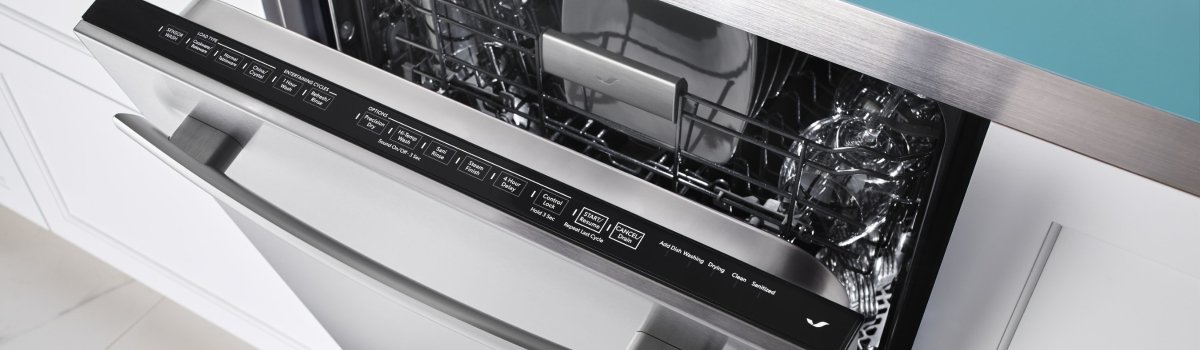
When a Jenn-Air dishwasher throws Error Code F5, it’s telling you there’s a water drain fault. In plain English: the machine tried to pump out dirty water and couldn’t. Sometimes it’s as simple as a kinked hose or a clogged filter; other times the drain pump, check valve, or a sensor is to blame. The good news? Many F5 cases can be diagnosed—and even fixed—without special tools.
What F5 Really Means (and how it shows up)
You’ll usually see a cycle that runs normally until the drain step, then stalls, throws F5, and leaves water pooled at the bottom. You might hear the pump hum without much movement, or nothing at all if the pump can’t start. Dishes often feel gritty because rinse water can’t clear properly.
Why this fault happens
Dishwashers live in a messy world of food scraps, seeds, coffee grounds, and soap film. Over time, those collect in the filter assembly, sump, and drain hose. If the air gap (where fitted) or garbage disposal knockout isn’t clear, the machine has nowhere to send water. Less commonly, the drain pump impeller cracks or jams, wiring loosens, or the pressure/flow sensor misreads the water level and trips F5.
Safety first, then a clean reset
Before you reach inside, unplug the dishwasher or switch off the breaker. Give it a minute, then restore power and try a quick cancel/drain. If F5 returns, move on to the checks below.
Smart DIY checks that fix most F5 errors
Work from the easy wins outward. Many of these take 10–20 minutes.
- Clear the filters and sump
Remove the bottom rack. Twist out the coarse and fine filters and rinse them under warm water. Lift the filter screen and look down into the sump—pull out onion skins, pasta, glass slivers, and anything wrapping the mini chopper or impeller area. Reinstall the filters firmly so water can’t bypass. - Inspect the drain hose end
Follow the drain hose to where it connects—either to an air gap on the sink deck or to the garbage disposal. If you recently installed a disposal, confirm the knockout plug in the disposal inlet was removed. Loosen the clamp and check for sludge right at the nipple; clean if needed. Make sure the hose has a high loop up under the counter to prevent backflow. - Check the air gap (if present)
Twist off the cap, pull the insert, and flush out any gunk. An air gap blocked by seeds or scale will trigger F5 even when the pump is fine. - Listen to the drain pump
Start a Cancel/Drain. A healthy pump has a clear, steady pitch as water leaves. A loud hum with no flow suggests a jammed impeller; silence can mean no power or a failed pump. If you’re comfortable, remove the toe-kick, access the pump, and check for debris in the impeller cavity. - Straighten the hose run
Behind the dishwasher, verify the hose isn’t kinked or crushed when the unit slides back. Small kinks can act like a partial clog and only show up under load.
If the unit now drains cleanly, run a short cycle to confirm F5 is gone. If the code returns, the pump may be weak, the check valve stuck, or a sensor/control needs testing.
When a professional should step in
If you’ve cleared the filters, hose, and air gap and F5 still repeats, it’s time for meter-level diagnosis. A technician can test pump voltage and current draw, inspect the wiring harness, verify pressure/flow sensor readings, and replace the drain pump or check valve with the correct part for your exact model. Don’t keep cycling power and forcing drains—an overheated pump can fail permanently and risk damage to the control.
Preventing F5 in the future
A few low-effort habits dramatically cut down drain faults:
- Rinse big scraps off plates and empty seeds/bones into the trash before loading.
- Clean the filters monthly. It’s a two-minute rinse that protects the whole system.
- Run hot water at the sink for 10–15 seconds before starting a cycle so the dishwasher begins with hot water and detergent dissolves cleanly.
- Keep the drain hose high-looped under the counter and check it after any install or move to prevent kinks.
- Use the right detergent and dose. Too much soap = sludge; too little = grease film.
Quick reference: your action plan
- Power off, then on → try Cancel/Drain.
- Clean filters + sump, check air gap/disposal, and ensure a high loop.
- Inspect for kinks, clear the hose end, and listen to the pump.
- If F5 persists: schedule service for pump/sensor/wiring diagnostics.
Prefer to skip the guesswork? Our factory-certified dishwasher pros handle Jenn-Air daily with brand-level diagnostics and OEM parts. Same-day visits are often available.