
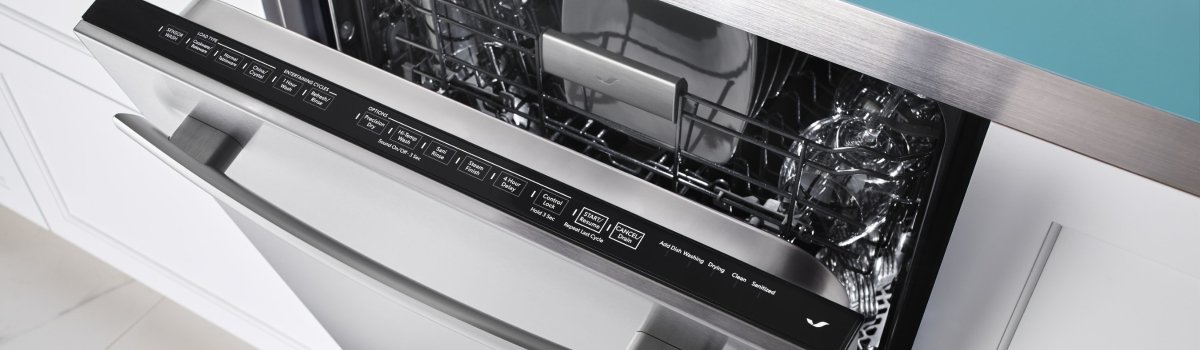
Seeing F4 on a Jenn-Air dishwasher usually means the machine isn’t filling with water the way the control expects. Think of it as a “no water / not enough water” alert. Sometimes it’s a simple supply issue at the shutoff valve. Other times, the inlet valve, filters, or sensors need attention. Below is a clear, no-jargon guide you can follow before calling for service.
What F4 Actually Means
During the first minutes of a cycle, the dishwasher opens an inlet valve and waits for the tub to reach a normal water level. If the control doesn’t “see” that level in time—through pressure/level feedback or current draw—it throws F4. You may hear the machine humming with no water entering, or it may abort the cycle early.
You’ll often notice one or more of these: the wash starts but sounds dry, detergent cake left in the cup, cloudy film after a very short run, or the cycle stops with F4 and a few beeps.
Why It Happens
Most F4 cases trace back to restricted water flow or a valve that won’t open. Common triggers include a closed or half-closed under-sink shutoff, a kinked supply hose, a clogged inlet screen (sediment, hard-water grit), or a failing inlet valve coil. Less often, a stuck float, a misread from the pressure system, or wiring at the valve can be the culprit.
Safe DIY Checks (Do These First)
Before touching anything electric, switch the dishwasher off and close the water supply under the sink.
Verify water supply at the source
Make sure the dishwasher’s shutoff valve is fully open. If your sink was recently serviced or winterized, this valve may be partially closed without you realizing it.
Look for a kinked or pinched hose
Pull the machine forward a few inches (if accessible) or check inside the adjacent cabinet. Supply hoses can flatten behind tight cabinetry.
Clean the inlet screen
At the dishwasher end of the supply line (where the hose meets the inlet valve) there’s often a tiny metal mesh screen. Shut water off, release the hose, and gently brush out sediment with a soft toothbrush. Reattach carefully—hand-tight plus a small tweak is enough.
Float and tub check
Open the door and find the float (a small dome or lever near the front corner of the tub). It should move freely up and down. If it’s stuck in the “up” position (food debris, a utensil), the control will think the tub is already full and won’t open the valve.
Listen for the valve
Restore water and power, start a cycle, and listen in the first minute. A healthy valve gives a clean “click” and you’ll hear water rushing in. A faint buzz with no water, or silence, points to a stuck or failed valve.
If F4 returns immediately after these checks—or you see seepage at the valve connection—stop and schedule service. Running dry can stress the circulation pump and heater.
A Closer Look at the Fault
Behind the kickplate lives the water inlet valve: a small solenoid-driven part that opens when energized. With age and minerals, the internal plunger sticks, the coil weakens, or the filter loads up. The control interprets the slow or absent fill as F4. On some models, wiring at the valve can also loosen from vibration, causing an intermittent F4 that appears and disappears mid-cycle.
Practical Fixes You Can Do
You don’t have to rebuild the machine—stick to what’s reasonable and safe.
- Replace a worn supply hose if it’s kinked or older than ~5–7 years. Use a stainless braided line rated for dishwashers.
- Install or refresh a sediment filter on the home water line if you have well water or frequent municipal work.
- Level the dishwasher so the float and door seal behave correctly; a front-low tilt can change fill behavior.
If the inlet valve itself is bad, replacement is straightforward for a trained tech and ensures the correct part number, gasket fit, and leak test.
When to Call a Pro
Call in a technician if:
- F4 returns after the above checks and a full power reset (flip the breaker off for 5 minutes).
- You don’t hear water flow in the first minute of a cycle, or you only hear a faint buzz.
- There’s visible corrosion at the valve, dampness under the machine, or burnt/loose wiring at the valve connector.
- F4 appears mid-cycle after a partial fill—this can point to control, pressure/level sensing, or harness faults that need metering.
A pro will measure valve coil resistance, verify voltage during fill, inspect the float/pressure system, and replace the valve or related parts with the correct Jenn-Air spec.
Preventing F4 in the Future
Keep water clean and flowing and the problem is unlikely to return.
- Run a hot water purge at the sink before starting the dishwasher so the inlet sees hot, debris-free water immediately.
- Every 6 months, check the inlet screen and vacuum any dust from behind the kickplate to keep electronics cooler.
- Use rinse-aid and manufacturer-approved cleaners monthly; they help reduce mineral buildup that can stick floats and plugs.
- After plumbing work or renovations, recheck the shutoff valve and hose routing—these are the easiest “oops” causes of F4.
- If you’re on hard water, consider a softener or point-of-use filter to protect the valve and spray system.
Prefer a fast, no-guesswork fix? Our factory-certified dishwasher specialists handle Jenn-Air every day and carry OEM parts for first-visit repairs in many areas.