
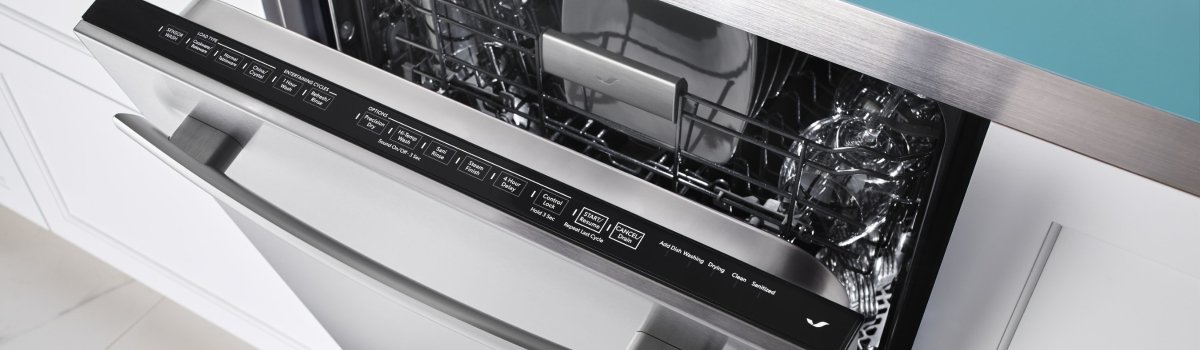
When a Jenn-Air dishwasher flashes F3, it’s calling out a temperature sensor fault. In plain English: the machine isn’t getting a believable temperature reading from the sensor (also called a thermistor/NTC), so it pauses or ends the cycle to protect itself. You might notice lukewarm washes, poor drying, or cycles that stop early—often with F3 on the display.
What F3 Actually Is
Inside the tub, the control board expects a smooth temperature curve as water heats. If the sensor reads open, shorted, or wildly out of range, the control throws F3. Sometimes the sensor is perfectly fine and the problem is a loose connector, a nicked wire, or scale and detergent residue insulating the probe from hot water.
Typical signs you’ll see
- Cycles that stall or finish cold
- Cloudy glasses or greasy film after “completed” washes
- F3 reappearing partway through a heated cycle
Why It Happens (The Root Causes)
Most F3 situations trace to one of four buckets:
- Sensor wear or failure
Thermistors age. If resistance drifts far from spec, the control flags it. - Connector or harness issues
Moisture, vibration, or heat can loosen a plug or corrode pins, making the reading unstable. - Lime scale and buildup
Heavy mineral deposits on the probe slow heat transfer, so the control “thinks” water never warms correctly. - Water-heat conditions
Incoming water too cold, heater not energizing, or a tripped high-limit can all confuse temperature tracking and trigger F3 on some models.
Safe First Steps (Before You Grab Tools)
Unplug the dishwasher or switch off the breaker. Give yourself good lighting and a small bowl for screws. Take a quick photo before you disconnect anything—you’ll thank yourself later.
Quick checks that fix many F3 codes
- Power reset at the breaker for 5 minutes
- Reseat the sensor connector (inside or under the tub depending on model)
- Inspect visible wiring for nicks, crushed sections, or heat discoloration
- Run a hot water tap at the sink for 30–60 seconds before starting a cycle (helps borderline cases)
If F3 returns immediately after a reset, move on to deeper DIY.
DIY Fix: Step-by-Step (Beginner-Friendly)
Read through once, then work slowly. If anything looks different on your model, stop and consult your manual.
1) Access the sensor
On many Jenn-Air units the temperature sensor sits low on the tub, often near the sump. Remove the lower rack and spray arm for room. Some models let you reach it from below (toe-kick off), others from inside the tub.
2) Clean the area
If you see white mineral scale, gently clean around the probe with warm vinegar and a soft brush. Rinse and dry. Scale can “insulate” the sensor and skew readings.
3) Reseat and secure the connector
Pull the sensor plug straight off, check for moisture or greenish corrosion, and push it back until it clicks. Loose pins are a classic intermittent F3 trigger.
4) Visual harness check
Follow the two sensor wires. Look for pinched spots where panels meet, or rub marks on metal edges. If you find a nicked section, don’t tape it and hope—replace that segment or have a tech do it with the correct gauge and insulation.
5) Resistance test (optional but helpful)
With power still off, use a multimeter to measure the sensor’s resistance at room temperature and compare to your model’s spec (commonly around 10kΩ at ~77°F / 25°C for many NTCs, but verify your manual). A reading wildly off-spec (near 0Ω or infinite) means replace the sensor.
6) Reassemble and test
Restore power, run a short heated cycle. Listen for water heating and check mid-cycle door warmth. If F3 stays gone, you’ve likely solved it.
When You Should Call a Pro
- F3 returns after cleaning and reseating
- Sensor measures out of spec and you’re not comfortable replacing it
- The heater never energizes (no warmth on the door mid-cycle)
- You find wiring damage or corroded multi-pin plugs under the unit
A technician will ohm the sensor against a temperature chart, meter voltage to the heater, check the high-limit/relay on the board, and replace the sensor or sub-harness with the correct part for your exact model.
Smart Prevention (So F3 Doesn’t Come Back)
Keep things simple and routine:
Run hot starts.
Before pressing Start, run the kitchen tap until water is hot. Dishwashers heat better when they don’t begin with a tub full of cold water.
Use rinse-aid and the right detergent.
It improves drying and reduces residue on the probe. Skip “more is better”—over-dosing leaves film that insulates the sensor.
Descale on a schedule.
In hard-water areas, use a monthly dishwasher cleaner or white-vinegar cycle (consult your manual for method). Less scale = more accurate temperature readings.
Mind loading and spray.
Don’t block the lower spray arm or pack tall items around the sensor area. Good circulation ensures the probe sees true water temperature.
Check connectors during deep cleans.
A quick reseat of accessible plugs after you remove toe-kicks or panels can ward off intermittent faults.
Quick Action Plan (Bookmark This)
- Kill power → reseat sensor connector → clean scale around probe
- Inspect harness for nicks or pinches
- Optional: meter sensor resistance and compare to spec
- Test a heated cycle with hot water primed at the sink
- If F3 returns: replace the sensor or book service for sensor/heater/control diagnosis